
A Musician’s Legacy
Your ways, O God, are holy. What god is so great as our God? You are the God who performs miracles; you display your power among the peoples. Psalm 77:13–14
Whatever your taste in music, the names of some composers echo down through the centuries: Ludwig van Beethoven, John Philip Sousa, and John Williams. In the era of King David, Asaph was a well-known composer. He was appointed by the Levites to serve as a temple musician—to sing joyful songs, accompanied by musical instruments (1 Chronicles 15:16–17). In 1 Chronicles 16:5, he is named as the chief of the musicians, or the minister of music, during King David’s reign. 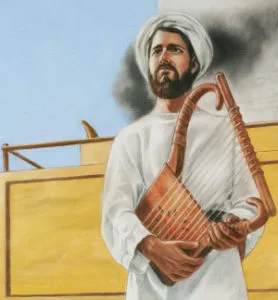
Twelve psalms are attributed specifically to Asaph, Psalm 50 and Psalms 73-83.[1] They reveal that Asaph was a godly man—one who served God faithfully, abhorred injustice, and encouraged others to keep their eyes fixed on the steadfast love of the Lord. In these psalms, Asaph affirmed God’s sovereignty, goodness, and power. He also spoke honestly about his own confusion and frustration during difficult times.
Asaph wrote one of my favorite verses in the psalter, Psalm 73:26—“My flesh and my heart may fail, but God is the strength of my heart and my portion forever.” So much in life befuddles me. Like Asaph I see “the prosperity of the wicked,” and wonder why God doesn’t do something about it (73:3). And like Asaph I sometimes think, “Surely in vain have I kept my heart pure; in vain have I washed my hands in innocence” (73:13).
But each time Asaph struggled, he returned to the truth that the Sovereign Lord was his refuge in the midst of all life’s swirling adversities (73:28). He clung to God’s rock-solid faithfulness: “You are the God who performs miracles; you display your power among the peoples” (77:14). And he turns to God who promised, “Open wide your mouth and I will fill it” (81:10).
Are you feeling unsettled or doubtful this week? Maybe the bad guys seem to be pummeling the good guys. Or perhaps adversity has prompted you to question God’s goodness or his faithfulness. Take a faith walk through Asaph’s psalms. Offer a prayer of thanks for the Spirit-inspired words of this composer. Breathe in the freshness of Asaph’s spiritual discernment, and let God restore your soul.
DIG DEEPER
About 300 years after David’s reign ended, Second Chronicles 29:30 reveals that Asaph was considered a “seer” during King Hezekiah’s time. Read Psalm 80 and 82. Why do you think later generations considered Asaph a prophet?
Asaph reviewed Israel’s history in Psalm 78. How did he describe God’s character? How did he describe the behavior of God’s people? What does the contrast between God and his people teach us?
Read Psalm 76. Why was Asaph giving thanks to God? What triumphs are you celebrating today?
Denise K. Loock
This devotion is part of our Not-As-Famous Men and Women of the Bible series.
[1] Many Bible scholars believe that some of the psalms attributed to Asaph were written by his descendants, who honored him by crediting their ancestor with these compositions. Merrill F. Unger says, “The titles of twelve psalms bear his name (50, 73–83) though in some of these (74, 75, 79) the “sons of Asaph” rather than Asaph himself should be understood, as matters of late occurrence are referred to.” Unger’s Bible Dictionary (Chicago: Moody Press, 1988), 111.
Comments
Thank you for a beautiful devotion we need to keep praising Him
Amen Kathy
Thanks Denise and Nancy, He’s worthy of our praise and devotion